have more knowledge of the terms used in heat transfer
Convection heat transfer coefficient
phrase
convective heat transfer coefficient is dependent upon the physical properties of the fluid and the physical situation. The convective heat transfer coefficient is not a property of the fluid. It is an experimentally determined parameter whose value depends on all the variables influencing convection such as the surface geometry, the nature of fluid motion, the properties of the fluid, and the bulk fluid velocity.
Example: the convective heat transfer coefficient for laminar flow is relatively
es: Coeficiente de transferencia de calor por convección
Critical Reynold’s number
noun
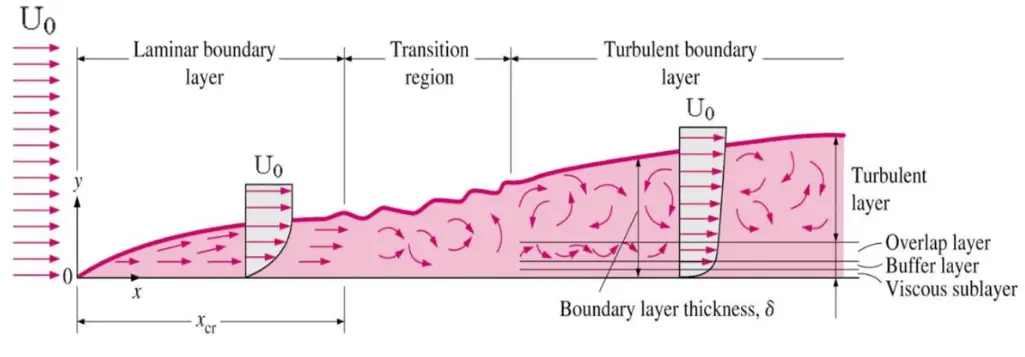
The critical Reynolds number is associated with the laminar-turbulent transition, in which a laminar flow becomes turbulent. This is an extraordinarily complicated process, which at present is not fully understood.
Example: Critical Reynolds Number for Flow in a Pipe
es: Número crítico de Reynolds
Friction Coefficient
phrase
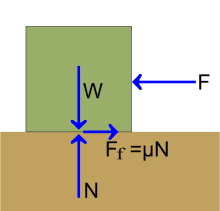
Coefficient of friction, ratio of the frictional force resisting the motion of two surfaces in contact to the normal force pressing the two surfaces together. It is usually symbolized by the Greek letter mu (μ). Mathematically, μ = F/N, where F is the frictional force and N is the normal force. Because both F and N are measured in units of force (such as newtons or pounds), the coefficient of friction is dimensionless.
Example: The coefficient of friction has different values for static friction and kinetic friction
es: Coeficiente de fricción
Kinematic viscosity
phrase
The kinematic viscosity is an atmospheric variable defined as the ratio between the dynamic viscosity μ and the density ρ of the fluid, i.e. (7.25) and depends on both air temperature and pressure.
Example: Kinematic viscosity is a measure of a fluid's internal resistance to flow under gravitational forces
es: Viscosidad cinemática
Laminar flow
phrase
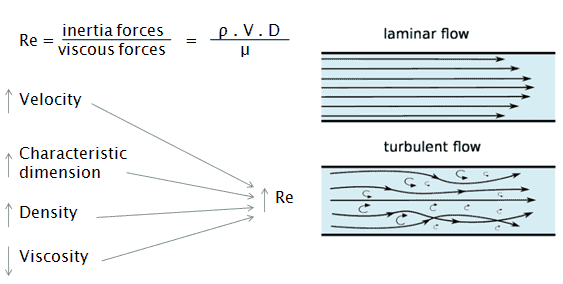
laminar flow or laminar current to the movement of a fluid when it is ordered, stratified or smooth. In laminar flow, the fluid moves in parallel sheets without intermingling and each fluid particle follows a smooth path, called a streamline. In laminar flows, the lateral transport mechanism is exclusively molecular.
Example: Laminar flow is typical of fluids at low velocities or high viscosities
es: Flujo laminar
Nusselt number
noun
a dimensionless parameter used in calculations of heat transfer between a moving fluid and a solid body.
Example: The Nusselt number (Nu) is a dimensionless number that measures the increase in heat transfer
es: Número de Nusselt
Prandtl number
noun
The Prandtl number (Pr) or Prandtl group is a dimensionless number, named after the German physicist Ludwig Prandtl, defined as the ratio of momentum diffusivity to thermal diffusivity
Example: The Prandtl number is often found in property tables alongside other properties such as viscosity and thermal conductivity.
es: Número de prandtl
Reynold number
noun
The Reynolds number (Re) helps predict flow patterns in different fluid flow situations. At low Reynolds numbers, flows tend to be dominated by laminar (sheet-like) flow, while at high Reynolds numbers flows tend to be turbulent. The turbulence results from differences in the fluid's speed and direction, which may sometimes intersect or even move counter to the overall direction of the flow (eddy currents). These eddy currents begin to churn the flow, using up energy in the process, which for liquids increases the chances of cavitation. Reynolds numbers are an important dimensionless quantity in fluid mechanics.
Example: The Reynolds number has wide applications, ranging from liquid flow in a pipe to the passage of air over an aircraft wing
es: Número de Reynold
Shear stress
phrase
Shear stress, often denoted by τ (Greek: tau), is the component of stress coplanar with a material cross section. It arises from the shear force, the component of force vector parallel to the material cross section. Normal stress, on the other hand, arises from the force vector component perpendicular to the material cross section on which it acts.
Example: Beam shear is defined as the internal shear stress of a beam caused by the shear force applied to the beam.
es: Esfuerzo cortante
Turbulent flow
phrase
Turbulent flow, type of fluid (gas or liquid) flow in which the fluid undergoes irregular fluctuations, or mixing, in contrast to laminar flow, in which the fluid moves in smooth paths or layers. In turbulent flow the speed of the fluid at a point is continuously undergoing changes in both magnitude and direction. The flow of wind and rivers is generally turbulent in this sense, even if the currents are gentle. The air or water swirls and eddies while its overall bulk moves along a specific direction.